Sunday, June 1, 2014

Ladybugs

Back in January, I started to work with a new client who I will call "June." Much like the other pro bono clients whom I have helped obtain asylum in the U.S., June has been through hell and back. There's no doubt that she is traumatized by what she has endured, just as anyone in the world would be.

A few months ago, June had to visit Boston for an immigration court hearing. For logistical reasons, and given the fact that June suffers great pain when she sits for long, I offered up my parents' house for June and her small entourage to stay the night before the hearing. Brian and I don't have any extra bedrooms in our house, and since my parents do, they graciously agreed to host three complete strangers without so much as a pause. 

The night before the hearing, we all gathered for pizza. It was one of the most precious nights of my life--watching a group of people from such (such) different backgrounds come together for some cheese pizza, vanilla cupcakes, and Sprite (all June's choices).  

The night of the pizza dinner, my parents and I all got home from work early to prepare for our guests. I picked up the food, my mom set the table with place mats and cloth napkins, and my dad turned on music and nice lighting. I was excited, and a bit nervous, to welcome our guests to my parents' beautiful home.  

Sometime before dinner, I noticed that my mom had placed a small glass ladybug at each person's place setting. My mom likes to collect cute things like that and little (and big) pieces of art decorate the entire house. Through June's interpreter, we discussed how the ladybugs would be good luck for the hearing the next day. We ended up needing luck, and for whatever reason (perhaps the ladybugs?), we got it. 

A month or so later, I was standing at a cash register at a gift shop. On the counter I spotted a basket of tiny glass ladybugs. Each one was $1. I bought one for June. 

This past Friday morning, still nauseous from the two hour bus ride that I need to take to reach June every time I see her, I dug around my briefcase for the little mesh bag with the ladybug in it. When I found it, I handed it to June, who looked totally confused and curious as to what I could have brought her. 

June didn't even open the mesh bag. The moment she saw the tiny ladybug through it, she gasped, put her hand over her mouth, and started to weep. I hadn't anticipated her reaction beyond hoping that she smiled, and this reaction was most certainly not one I had expected. June continued to weep, shaking, and holding the mesh bag up to her heart. 

I gave her some time and sat, a bit stunned, thinking about what in the world I should say. 

Finally, I told June she was so kind to be so grateful. Her interpreter told her what I said in her language. She continued to weep and shake and hold the ladybug up against her chest. 

I tried to make a joke. "Wow! That $1 was the best dollar I have ever spent!" Even before the translation, June laughed. Honestly, it was. 

A minute later, June tried to collect herself to tell me something. I will never ever forget what she said. As her interpreter translated it for me, I watched June. "It's not how much it cost," she explained, "It's that this shows me that you were thinking of me. It shows me that I'm not alone." 

"You're not alone," I told her. 

A few minutes later, we got down to work. 

*   *   *

Prior to getting cancer, when my clients would cry while recounting their tragic stories, I felt like I should do something to help stop their tears. I wanted to be able to say the right thing or make a joke or distract them so that they wouldn't have to feel all the pain that I saw them feeling. 

Cancer changed me in this regard. I explained this to June during a prior meeting when she was having a terribly hard time controlling her emotions. She was clearly distraught by the very fact that she was distraught; a whole other layer of pain that I knew she didn't need to endure. I explained to June (who already knew that I had cancer) that our situations were obviously very different, but that it was okay to cry. I told her that I can hold it together pretty well 99.9% of the time, but without fail, every time I see my oncologist, I bawl my eyes out in the exam room. So much fear and pain that I hold in comes pouring out to his person that I have trusted to solve my biggest problem. Not that I mean to compare myself to Dr. Bunnell in this analogy (conceited much?), but my point was only that sometimes we all have a space where, for whatever reason, stuff that we keep inside just can't stay packed up anymore. I told her my colleague and I were happy to provide one of those spaces. 

I still hate to see my clients cry, but when they do, I no longer feel like I need to stop their tears. I know I can't take away their pain just like Dr. Bunnell or Dr. Fasciano can't take away mine. So I give them time and space to cry. I listen. And I think about how to help them get through what we need to cover in that meeting with as little discomfort as possible. 

Still, for all I have written about, reflected on, and bottled up regarding my cancer journey, I never expected that June would help me better understand it by her reaction to the little $1 ladybug. But she did. What June said to me last week made little puzzle pieces in my mind come together. She was so truly right. When I am my most scared about cancer, or anything, for that matter, it's when I feel alone.

Last week, on my bus ride back from that meeting with June, I thought about June's reaction to the $1 gift I gave her. I felt awful motion sickness, but I also felt pride. The little glass ladybug had done for someone else what so many others have done for me -- it helped June feel less alone. And for that, I will allow myself a moment to feel infinitely blessed.


Sunday, May 25, 2014

Still here and still writing

I just wanted to let everyone know that despite that I have been absent from the blog, I have been writing just as much as usual. For some reason, in May, I became obsessed with writing the Introduction to the book and finding the perfect title, both of which I believe I have now done. I cannot wait to share so stay tuned. Thank you all for your never ending support.

Thursday, May 1, 2014

The Book (Part One)

Earlier this week, I finished the first draft of my book—three hundred and forty seven pages of real life; of new stories, and of stories born from this blog. Despite the perfect fonts that I found for the chapter headings, those 347 pages need work, lots of work, and even after the upcoming months of editing, there’s a very good chance that I collect enough rejection letters from publishing houses to decide to self-publish. Nevertheless, which company prints and binds that book does not matter to me. Because what I made and how I made it already feels like one of the proudest accomplishments of my life.

Writing the draft of the book was, at times simultaneously, an extremely painful and deeply fulfilling experience. It was hard for many reasons, including that I am a loyal member of a generation that much prefers the immediate kind of gratification to the delayed kind. More than that, however, was the challenge of not only revisiting some of the most difficult times in my life, but also reliving them. I couldn’t help but become entrenched in the memories, many of them scary and painful, and some of them wonderfully precious, as I described them in more (or less) detail and reflected on them with a more developed and informed perspective. A few times, the recollections caused me so much anxiety that I needed to stop and walk away, but I was always able to return and finish the chapter, even if it was totally crappy, and even if my hands still felt shaky on the surface of my keyboard.

Another great challenge of writing that draft is that life didn’t pause for me to do it. Lots of stuff, both good and bad, happened in the ten months that I have been working on the book and many of those events shaped a new understanding of experiences that I had already put down on paper. Should I go back and edit my earlier thoughts on a topic considering what I think about it now? Or should the book be transparent about how those understandings developed? These types of decisions weren’t, and still aren’t, easy ones.

I first conceived of writing the book after several people told me that the blog had helped them process a difficult time in their own life. They emailed me with messages about how they had come across the blog and read hundreds of posts from it, like it was a book. They told me that my story gave them hope. I loved that my story had somehow given them hope because I knew that when others gave me hope, it was the most precious gift I had ever received.

At the same time, I knew the blog is often a rambling mess. It jumps around in time and in theme and I know there are still grammar and spelling mistakes all over it (gasp). When I write in the blog, it is for my own emotional therapy, and I can never predict when I will feel like telling a certain part of my story. Therefore, the blog tells a story out of chronological order and I knew that whoever tried to read it like a book could eventually despise its organization or lack thereof. There was no doubt—I needed to reshape the story, and in other parts, tell it for the first time. The blog was raw, and as far as blogs go, that was fine, but last year, I started to want to create something more refined; something cleaner, even if it addressed topics that often felt like heaps of a big shitty mess.

In the end, I wanted to create something that my loved ones and strangers alike could hold in their hands—a place to find even just a glimmer of hope in the face of cancer or any other life challenge.

Over time, however, my motivations evolved into something quite different than all of that.

I still cherish the concept of hope, but I’ve arrived at an issue with it—it’s innately forward-looking. That’s not necessarily a bad thing, but looking forward is pretty complicated, particularly in the world of aggressive forms of cancer, and particularly when I have, in the last few months, come face to face with several stories of metastatic disease and with my own deep-seeded fear that my own cancer had returned. By no means am I saying that these experiences have caused me to give up hope for my own future or for that of others because indeed, they have not. Rather, these experiences have started to help me learn how to relax my somewhat-toned hope muscles. And in a way, relaxing those muscles is just as important, and as difficult, as flexing them.

Part of what lead me to this evolution in my relationship with hope is a newfound interest in meditation. A good friend and I have been taking a class during our Wednesday lunch breaks on "mindfulness based stress reduction" and what I have learned there has changed me in a good, solid, balanced sort of way. Granted, I don't stop to listen to my meditation tapes often (a few times a week if I'm lucky), but I love that short time when I find it. I totally suck at meditating because just a few minutes into following the instructions to observe my breath or relax the muscles in my face, without fail, I fall asleep for the rest of the time. I've gathered that it's hard to meditate well when you can't stay awake for it, but still, I love the principles of the practice. In fact, the “I am here now” perspective that I clung to in my darkest times is at the core of those principles. Thus, in a way, I had a solid head start.

Perhaps the biggest lesson that the class has taught me is that my mind and my body are so very often in two completely different places. I'm trying to learn to keep them in the same place at the same time—to live, in good and bad times, by the idea that I am here now, and to see, hear, smell, and feel more of that now.

This practice at first made me wonder if hope is innately at odds with the idea of living in the present moment. When we hope, aren't we really just wishing for something in the future? If so, are we wasting valuable energy hoping—energy that could be used observing and maybe even appreciating the present? Sometimes, yes, I may waste energy that way. But I've come to realize that hoping and being present are not necessarily at odds.

To Be Continued…

Wednesday, April 16, 2014

Truth, Lies, and Billboards

I don’t know anything about advertising except for what I’ve learned watching Mad Men. When I taught an economics course to high school seniors years ago (long before Mad Men), we spent a few days talking about advertising in a unit when my students designed their own business plans. Since I didn’t know what I was talking about then either, I chose not to talk much on the topic, and instead, late at night on Super Bowl Sunday, I sat at my VCR (remember those?) and video-taped the commercials off of my then-so-innovative DVR. It took forever to prepare that tape of Super Bowl ads and I would have given anything for something like YouTube, which came a few years later. It was worth my effort, however, because we all found it fascinating to analyze the biggest and best efforts from the nation’s top advertising agencies.

Within that context, I don’t claim that it’s easy to design a successful advertising campaign. In fact, it must be amazingly difficult to sell something, even to a small portion of the public, considering that even that small portion consists of individuals with a great diversity of perspectives.

Take, for example, a campaign to sell cancer services. One may think that a billboard for a cancer clinic would have a relatively homogeneous audience (cancer patients). A short minute of thought, however, would probably lead one to realize that cancer patients, even, for instance, breast cancer patients, come to the highway with a wide range of experiences and outlooks. Thanks to breakthroughs like Herceptin, some breast cancer patients have been told that their chances at a long life are quite good. But others face metastatic disease and they have been given time frames that they and their loved ones can barely comprehend. 

*   *   *

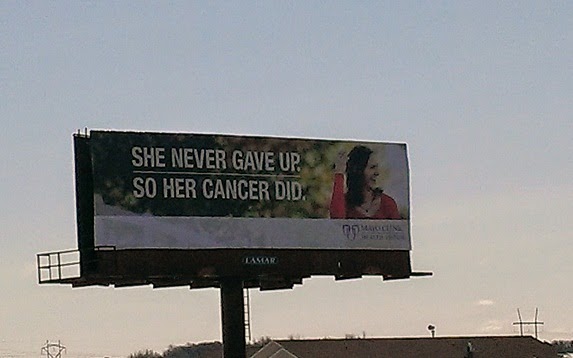
Today, thanks to a Facebook post, I saw a photo of a billboard that is on the side of the highway somewhere in Wisconsin. This is the photo, taken by a breast cancer survivor, Nancy Stordahl, who writes a blog that I may read if I ever get up my courage to.

http://nancyspoint.com/when-a-cancer-billboard-is-offensive/

You can see the image and read the print. A beautiful, young, happy, and healthy-looking woman, (with long hair, mind you) who "never gave up." "So her cancer did." 

Since this afternoon, my reactions to this billboard have been all over the map. At first, I just thought about how dumb and ridiculous it was. I wondered what group of clueless bozos thought this was a good idea. Then I got back to my work. 

As my mind drifted back to the sign, however, I couldn't help but connect it with some terrible news I heard yesterday from a dear friend. When my mind made the connection, an anger in me started to brew. 

Yesterday, I met up for coffee with a friend of mine who I haven't seen in far too long. Without going into details (my friend's privacy is important to her), my friend told me that her mother's breast cancer had returned and was in her bones. We both know the seriousness of this sort of a diagnosis so we sat in Starbucks and cried together intermittently for over an hour. We were completely oblivious to everything else going on around us, and we wiped our huge tears with brown paper napkins. 

Today, as my mind continued to dwell on that stupid billboard, I thought about my friend's mother, who I will call "Monica." I wondered how Monica would feel driving by that sign. I ultimately concluded that I have no idea. Perhaps she would feel inspired by it. Perhaps she would feel, "Yes, right, I will never give up!" Or perhaps she wouldn't even care what the Mayo Clinic had to say. I don't know Monica enough to know how she would feel about that sign and Monica, like every person, can speak for herself. Still, tonight I wanted to take the time explain what I think is wrong about that sign; why I would probably join Monica or my friend, or even my own mother, if they ever flipped the bird to a sign like that.  

One wrong thing about that sign is that it boils down a very complex experience into a misleadingly simple one. It's especially stupid because if we could beat cancer by sheer determination, the disease would have been erradicated decades ago. Obviously, however, we can't, and in her blog, Nancy explains much of that so nicely that I will not repeat it. 

I will, however, offer my own additional thoughts on the matter. 

When I was first diagnosed with cancer, catch phrases about beating cancer were like spinach to my hope muscles. Battle Mode. LiveStrong. Total recovery, Full stop, Checkmate, I win. These small words were wonderfully powerful to me. They helped me believe that I would live. That cancer would not kill me. They helped me believe that I could control my own destiny. That I could be strong and my doing so would make a difference in my future. 

At the time, I needed that sort of simplistic clarity, mostly because I couldn't process the complex grey area in which I lived. I couldn't process the future. I was in my own individual survival mode, and in that mode, I needed to believe one thing and one thing only -- that I could beat cancer. That I would beat cancer. 

Gradually, for better or for worse (I have no idea which), I evolved. I emerged, reluctantly, from my cancer cocoon and started to see the complexity in so much of this awful disease, or better yet, in the beautiful and tragic life and death that the disease can touch. "Total recovery" and "I win" came to mean something so much deeper to me than avoiding death-by-cancer. In fact, I'm still figuring out what they mean, but I know the answer is not something that can be summed up in a blog, and it definitely wouldn't fit on a bracelet or a billboard. 

The truth is that I struggle every day to walk a fine line. On one side of that line is acceptance of the reality of a deadly disease. On the other side is sheer defiance of that very same reality. Now that I think about it, I guess that means that the line itself is reality. It's that path that our bodies must physically walk as a million forces try to pull our spirit in equally as many different directions. 

One such force that tugs at me makes me want to write to the Mayo Clinic and tell them what a bunch of dopes they were to put up a billboard that could be so offensive to so many cancer patients, victims, and their loved ones. "Seriously, people, what were you thinking? Have you ever known anyone who died of cancer? Can you see how this billboard could suggest that those people 'gave up'? Hello in there? Anyone home?" 

I doubt that there was an ounce of malicious intent behind that billboard, however, which is why in the end, my anger about it was short-lived. I'd have to guess that someone simply dropped the ball in not running a draft of the billboard by a few cancer patients or caregivers. Because I'm confident that anyone who has touched the world of cancer, particularly, metastatic cancer, would have told them to find a new approach. Like ASAP.

Another force that tugs at me is one that tries to convince me to just find my own inner peace and ignore the hype around something like this billboard. Don't bother with it, the voice tells me. Just focus. Focus on today, on your family, on your book and on your work, on things you can do to really help, on things that make you happy. The billboard is just a stupid sign on the highway; a total fail by an advertising company that forgot to consider a large portion of their audience -- the portion for whom cancer is not curable no matter how much they hope or wish or pray. 

In the end, I realize that the stupid billboard did what almost all advertising does -- it painted an image that was not real. Anyone who has ever seen a McDonald's billboard and then ordered a Big Mac shouldn't be surprised. We all know about airbrushing, don't we? Yet we are surprised because we think that people who work in the cancer field should know better. Selling cancer services is not like selling soda or paper towels or age-defying face cream, and we're disappointed when the advertisers and those who hired them miss that point so badly. 

Disappointment. Yes. Disappointment. I guess that best sums up my feelings about the billboard. 

Disappointment. The concept also only barely sratches the surface of what I feel about Monica's recurrence, and Kristin's, and about every situation in which a person's body cannot physically overcome the ravaging effects of a brutal disease. I'm deeply, deeply disappointed. Because more than anything, I wish that the Mayo Clinic message were true. I'll take a soggy, flat hamburger and a papertowel that can't clean up a spill in one wipe. But I so truly wish that every cancer patient could beat the disease by simply not giving up. Unfortunately, the science just doesn't work that way, at least not yet, and no image or catchy slogan slapped up onto a billboard is going to change that. 

Finally, since I'm offering criticism, I feel it's only fair to be constructive about it. So, to the likely well-intentioned yet ill-advised Mayo Clinic, here's my two cents (or have I already reached $50.02?). Ditch the picture of the happy woman with long, thick, awesome hair. Ditch the catchy slogan. Ditch the airbrush and the vision of a promise that you can't yet fulfill. Instead, consider something like what I recently saw on a greeting card. Because this sort of honesty will probably make some cancer patients smile, and it may even give them a moment of peace. I've found that honesty has a tendency to do that. Even though it's not as pretty.  

Front of greeting card

Back of greeting card
(This card can be found at www.thatsallgreetings.com.) 

Sunday, April 6, 2014

Three Minutes of What I Most Want to Teach My Children

I never thought that the most important lessons that I'd want to teach my children could be rolled up into one three minute video but I think it just may be. And yes, the video is a commercial for a Thai insurance company. But forgetting the insurance company part, this really is beyond precious. And of course, it came from my mom.